
Water damage restoration in Toronto, approached the way a fine finish deserves
From a burst supply line in a Leslieville semi to a soaked basement rec room in North York, we treat every water event as a restoration project first and a cleanup second — with the drying science, documentation and finish quality to prove it.
Email Us for a Free Estimate
Why water damage in Toronto rarely behaves the way homeowners expect
Toronto's housing stock is a study in contrasts — century-old brick semis in Riverdale with original clay drain tile, mid-century bungalows in Scarborough on slab foundations, and glass-and-concrete towers downtown with recirculating mechanical systems. Water finds a different path through each of them, and a restoration approach that ignores those differences tends to leave hidden moisture behind.
Older brick and stone absorb before they show
In neighbourhoods like Cabbagetown or The Beaches, century homes have masonry that wicks moisture upward long before a stain appears on plaster. We check behind the visible damage, not just at it.
Freeze-thaw cycles stress foundations every winter
Ontario's swing between deep freeze and sudden thaw opens hairline cracks in foundation walls year over year, which is why so many GTA basement floods trace back to grading and freeze-thaw fatigue rather than a single dramatic failure.
New-build condos concentrate risk in shared systems
In towers along the waterfront and the Yonge corridor, a single failed valve or overflow can affect multiple units through shared risers, so containment and coordination with property management matter as much as the drying itself.
Lake-effect storms arrive with little warning
Weather rolling off Lake Ontario can dump intense rainfall in a short window, overwhelming older municipal sewers and window wells before a homeowner has time to prepare.
A wet basement is never just a wet basement
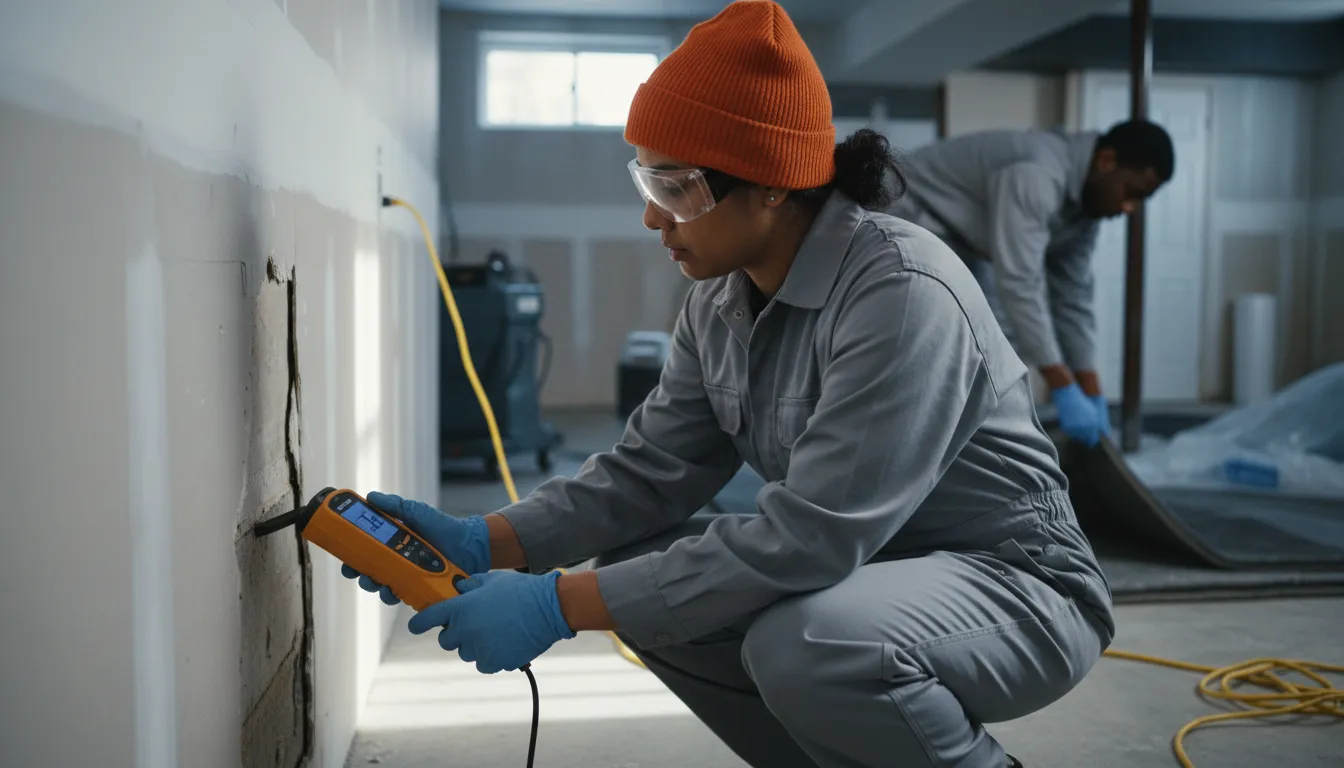
By the time water is visible on a basement floor in Etobicoke or a ceiling stain appears in a Danforth triplex, moisture has usually already travelled into subfloor, insulation and framing that no one can see. Left alone, that unseen moisture becomes the seedbed for mould, warped trim and the kind of slow structural fatigue that shows up as a much larger bill eighteen months later.
We dry to a standard, not to a feeling
Our process starts with moisture mapping so we know exactly where water travelled, followed by extraction, engineered airflow and monitored dehumidification until materials reach a verified dry standard — not until the surface looks dry to the eye. That discipline is what protects hardwood, plaster and finishes that took real craftsmanship to install in the first place.
Restoration services across the GTA
Each service below is its own discipline, applied with the same careful, documentation-first approach.
Emergency Water Mitigation Toronto
Rapid-response containment and extraction to stop a water event from spreading further into a Toronto home.
Learn moreFlood Cleanup Toronto
Full cleanup after basement or storm flooding, from standing water removal through to sanitizing affected materials.
Learn moreSewage Cleanup Toronto
Careful, biohazard-aware remediation of sewage backups common in older GTA sewer-connected homes.
Learn moreStorm Damage Restoration Toronto
Restoration for wind-driven rain, roof intrusion and lake-effect storm damage across the Toronto area.
Learn moreStructural Drying Toronto
Engineered drying plans that bring framing, subfloor and masonry back to a verified moisture standard.
Learn moreWater Extraction Toronto
High-capacity extraction of standing water from basements, main floors and finished lower levels.
Learn moreWhat sets a considered restoration apart
Anyone can point a fan at a wet carpet. Restoring a home properly asks for more discipline than that.
Documentation built for adjusters
Moisture readings, photos and drying logs assembled the way a Toronto insurance claim expects to see them.
Respect for finishes
We work around hardwood, built-ins and plasterwork with the same care a finish carpenter would bring.
Responsive by email
Send details any hour and hear back promptly — no hold music, no dispatch guesswork.
Whole-home perspective
We look at how water moved through the structure, not just where it happened to pool.
Environmentally considered drying
Efficient equipment and sensible chemical use, chosen with the household's air quality in mind.
Tradesperson's attention to detail
The same precision we'd want in our own homes, applied to every basement, kitchen and crawlspace we touch.
How a restoration unfolds, start to finish
A clear sequence, communicated plainly, so nothing about the process feels like a mystery.
- 1
Email us the details
A few photos and a short description of what happened lets us understand the scope before we arrive.
- 2
On-site assessment and moisture mapping
We identify how far water has travelled through the structure, not just where it's visible.
- 3
Extraction and containment
Standing water is removed and the affected area is contained to prevent further spread.
- 4
Monitored structural drying
Engineered airflow and dehumidification continue until materials reach a verified dry standard.
- 5
Documentation and hand-off
A clear report is prepared for your records or your insurance adjuster, with the space restored and ready.
Questions Toronto homeowners ask us most
How quickly should water damage be addressed in a Toronto home?
As soon as it's noticed. Materials common in GTA homes — plaster, hardwood, older subfloor — begin absorbing moisture within hours, and the longer that moisture sits, the more of the structure eventually needs attention. Email us as soon as you spot an issue and we'll advise on next steps.
Do you work directly with insurance adjusters?
Yes. Our documentation, moisture logs and photos are prepared in a format adjusters across the GTA are used to reviewing, which tends to keep claims moving without back-and-forth.
Why does my basement flood every spring but not every winter?
Spring thaw sends a sudden volume of meltwater into soil that's still partially frozen, so it has nowhere to drain except toward foundation walls — a pattern we see across Toronto's older basements every year.
Can you restore hardwood floors after a water event, or do they need replacing?
Often they can be saved. It depends on how long moisture sat and how the wood was installed, which is why we assess before assuming the worst — replacement is a last resort, not a first instinct.
Do you only work on basements?
No. We restore kitchens, bathrooms, main floors and condo units throughout the GTA — anywhere water has travelled somewhere it shouldn't have.
How do I get a quote?
Email us with a description and photos of the affected area, and we'll follow up promptly with next steps and a clear quote.
Coverage map
Serving the Entire Greater Toronto Area
5 regions, 29 communities — wherever you are in the GTA, Toronto Water Damage Restoration is close by. Pick your area to see how we can help.
Let's assess the damage properly, before it becomes a bigger project
Email us today with a few details and photos, and we'll respond with a clear plan for restoring your Toronto home.
Email Us for a Free EstimateWeather drives water-damage risk — email us if you find water.
Fall water-damage conditions in Toronto, ON
Fall rain around Toronto, ON tests gutters, sump pumps, and foundations; catching leaks and seepage early prevents the slow water damage and mold that surface over winter.
Proudly Serving Toronto, ON
Local, on-time service throughout Toronto and the surrounding area.